
Which Piercings Actually Suit Your Ear Shape
Aug 26, 2026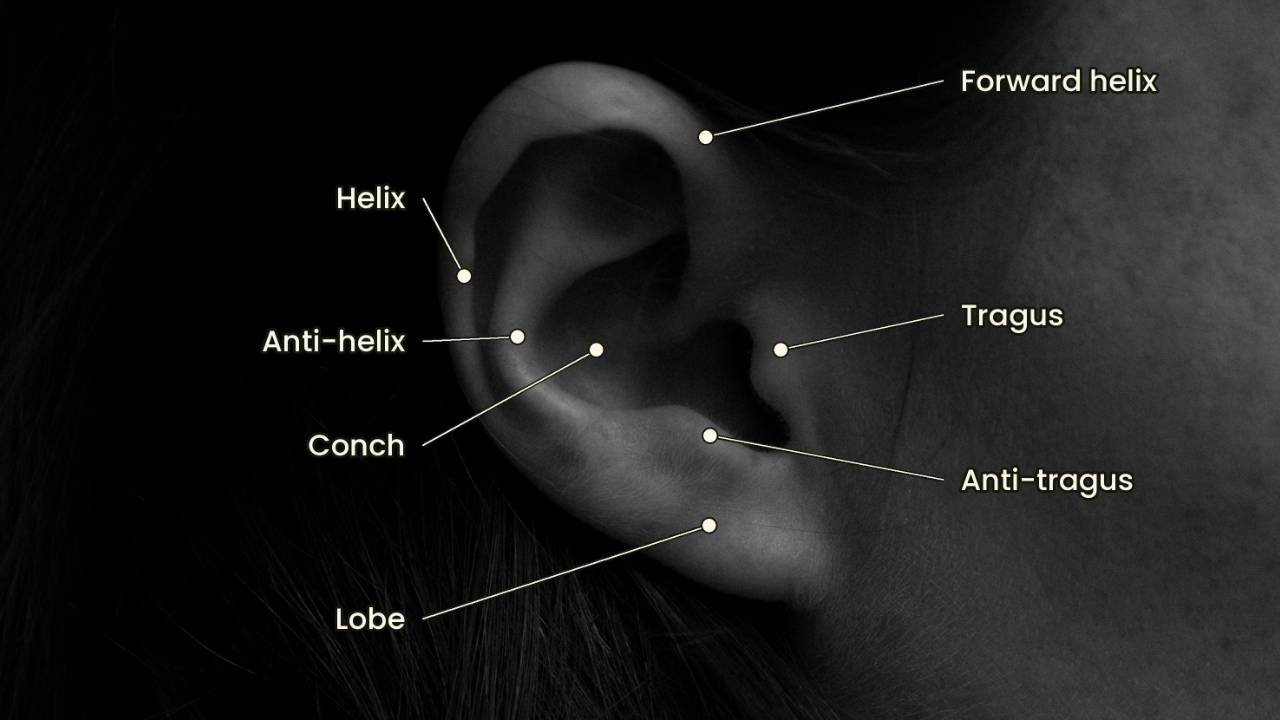
You have a folder of saved ears. Someone else's helix curve, someone else's rook, someone else's perfectly balanced constellation. You bring it to your piercer, and they tell you your ear won't do that.
That is not bad news. It just means the conversation started in the wrong place.
Before style comes anatomy. Every ear has a different set of ridges, folds, and hollows, and those decide which piercings are even possible before taste enters the picture. The stacks that look effortless are usually the ones built around what the ear already offers, not the ones forced onto it.
Here is how to read your own.
Start With The Map
Five areas do most of the work.
The lobe is the soft tissue at the bottom. Most flexible area on the ear, and the easiest place to add without much planning.
The helix is the outer rim, curving from the top of your ear down toward your head. The forward helix is where that rim tucks in near your temple.
The anti-helix is the raised ridge just inside the outer rim. Some people have a pronounced one. Some barely have it at all. This single feature decides more than any other.
The conch is the bowl in the middle, the shell-shaped hollow around the ear canal.
The tragus is the small flap covering the canal, with the anti-tragus sitting opposite it.
Stand at a mirror in good light and find each one. That is your working map.
Piercings Your Anatomy Decides
Some placements are not a matter of preference. Your ear either accommodates them or it does not.
The rook goes through the upper fold of the anti-helix. It needs a defined ridge with enough depth to hold jewelry securely. If your anti-helix is shallow or flat, a rook will sit awkwardly, migrate, or simply not be possible.
The daith goes through the fold of cartilage above the ear canal. Some ears have a thick, pronounced fold that is ideal. Others have a thin one that makes placement difficult.
The snug runs through the anti-helix horizontally, and it is one of the most anatomy-dependent piercings there is. It needs a prominent ridge. Plenty of ears cannot take one at all.
The industrial connects two helix points with a single barbell. It requires those points to line up along a straight path. If your forward helix sits at a different angle than your upper helix, the bar will press against tissue instead of spanning cleanly.
The flat sits in the wide area inside the upper helix. It needs enough surface to work with.
If a piercer tells you one of these is not right for your ear, they are not being difficult. They are preventing a piercing that would reject, migrate, or hurt far longer than it should.
Piercings Most Ears Can Take
The good news is that the most versatile placements are also the most flexible.
Lobe piercings work on nearly everyone, and stacked lobes are one of the easiest ways to add rhythm to a stack.
Helix piercings suit most ears, and the outer rim gives you room to place them high, mid, or low depending on the shape you want.
Conch piercings, inner or outer, work for most people, though the depth of your bowl affects which jewelry sits well.
Tragus piercings depend on having enough tissue, which most people do, though the size varies more than you would expect.
Between those four areas, almost anyone can build a full, balanced stack. The anatomy-dependent piercings are accents, not foundations.
Build Around What You Have
Here is where intention comes in.
If you have a strong anti-helix, you have access to placements many people do not. A rook or a snug can become the anchor of your stack, and everything else arranges around it.
If your anti-helix is shallow, your ear is likely better suited to a stack that emphasizes the outer rim. Helix placements at varying heights, a conch, stacked lobes. That is not a lesser stack. It is a different composition, and it reads cleaner on your ear than a forced rook ever would.
If your ear is small, fewer piercings with more spacing will look more intentional than many crowded together. If you have more room, you can afford more density without it feeling busy.
The point is not to collect every placement. It is to choose the ones your ear wears well and let them relate to each other.
What To Do Next
Take a clear photo of your own ear in natural light, straight on and slightly angled. Most people have never actually looked at their ear closely, and the photo will tell you more than a mirror does.
Identify your anti-helix first, since it determines the most.
Then look at what you already have pierced and ask whether the next one adds to that composition or just fills a gap.
One thing worth saying plainly: this article helps you plan, but it does not replace a consultation. A reputable piercer will assess your anatomy in person, and they can see things a photo cannot. Ask them what your ear is suited for before you decide what you want. The best stacks come from that conversation, not from a screenshot.
Your ear is not a limitation. It is the brief.
